
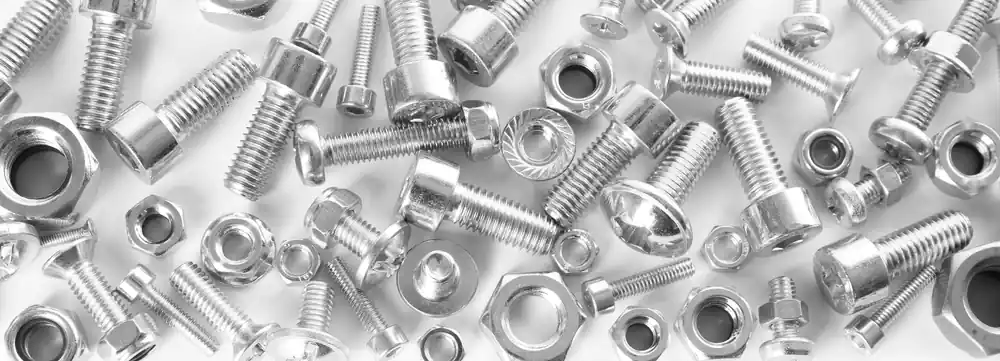
 Customers ask us about stainless steel fasteners every day. Sometimes they're replacing a rusted bolt that failed years sooner than expected. Sometimes they're working on a marine project and know they need additional corrosion resistance. Other times, they're comparing 304 vs 316 stainless steel and trying to determine whether the upgrade is actually necessary.
In our experience, those decisions become much easier once you stop thinking about the fastener and start thinking about the environment. A fastener doesn't know whether it's made from 304 or 316 stainless. It only knows what it's being exposed to: saltwater, chemicals, humidity, heat, and weather.
Those conditions ultimately determine which material makes the most sense, which is why stainless steel is available in several different grades designed for different applications. What works perfectly for one application may be unnecessary—or even the wrong choice—for another. That's why one of the first questions we ask is simple: Where is this fastener going to be used?
The answer often tells us more than the material specification itself. A fastener that's going on a boat has different requirements than one being installed on a piece of heavy equipment. Hardware used in a chemical facility faces different challenges than hardware used in a typical outdoor construction project. That's why understanding the application is always the first step.
Why Choose Stainless Steel Fasteners?
For most customers, the conversation starts with corrosion resistance. Stainless steel fasteners are less about appearance and more about avoiding future problems. They've dealt with rusted bolts. They've seen hardware seize up, deteriorate, or require replacement sooner than expected. They know the environment is working against them.
There's a reason stainless steel fasteners show up in everything from boats and docks to manufacturing facilities and construction projects. They offer a level of corrosion resistance that makes them well suited for environments where traditional hardware may struggle over time. That's why stainless fasteners are commonly used in:
- Construction projects and outdoor equipment
- Marine applications and coastal installations
- Chemical facilities and manufacturing plants
- Food processing environments
- Automotive and architectural projects
Corrosion resistance is usually what starts the conversation. Appearance, service life, maintenance requirements, and strength often determine where it ends.
Does Stainless Steel Rust?
One of the most common questions we hear is: Does stainless steel rust? The answer surprises some people. Yes, stainless steel can rust. In fact, if stainless steel couldn't rust, there wouldn't be different grades of stainless steel in the first place.
The important thing to understand is that stainless steel is highly corrosion-resistant — not corrosion-proof. Moisture, chemicals, saltwater, and weather all influence how a fastener performs over time, which is why stainless steel is available in a variety of grades designed for different levels of exposure. Choosing the right material starts with understanding what the fastener will be up against.
Do You Really Need 316 Stainless?
This is probably one of the most common stainless conversations we have. Many customers come in asking specifically for 316 stainless steel because they've heard it's the best option available. In some situations, they're absolutely right. In others, they may be paying for performance they don't actually need.
If saltwater, chemicals, or constant moisture are part of the equation, 316 stainless may be money well spent. In the right environment, the added corrosion resistance can make a noticeable difference in longevity and performance. But that's not every application.
Many customers are surprised to learn that 304 stainless is more than capable of handling a wide range of outdoor, industrial, and maintenance-related applications without the added cost of upgrading to 316. That's why the application should drive the decision — not the reputation of the material. Sometimes the best recommendation is upgrading to 316; sometimes it's sticking with 304.
304 vs 316 Stainless Steel: What's the Difference?
For most customers, choosing stainless steel fasteners eventually comes down to 304 vs 316 stainless steel. Both materials offer excellent corrosion resistance. Both are widely used throughout the industry. Both have earned their reputation as reliable fastener materials. But they aren't designed for exactly the same environments.
304 Stainless Steel
If you've purchased stainless steel fasteners before, there's a good chance you've worked with 304 — even if you didn't realize it. 304 is the workhorse of the stainless world. It's often referred to as 18-8 stainless because it contains approximately 18% chromium and 8% nickel.
304 has become so popular because it offers a strong balance of corrosion resistance, strength, availability, and cost. Common applications include general construction, outdoor equipment, fencing, vehicles, decking, and architectural applications. For many projects, 304 stainless steel bolts provide all the corrosion resistance needed without additional costs.
316 Stainless Steel
This is where a lot of customers start asking questions. They know 316 is considered the premium option, but they aren't always sure whether they actually need it. The reason 316 exists is simple: some environments are harder on fasteners than others. Saltwater, coastal air, chemical exposure, and constant moisture are the situations where 316 begins to separate itself from 304.
That's why 316 stainless is commonly used in marine applications, chemical processing facilities, and high-moisture setups. It's also why 316 is often referred to as marine-grade stainless steel. The tradeoff, of course, is cost. And that's why the conversation shouldn't be about which material is better—it should be about which material makes the most sense for the application.
Is Stainless Steel Magnetic?
We've had more than a few customers pull out a magnet while trying to identify a fastener. It's a common field test — but it doesn't always tell the whole story. One of the biggest misconceptions surrounding stainless steel is that it should never be magnetic.
In reality, magnetism can tell you something about a fastener — but it doesn't tell you everything. While many common stainless materials, including 304 and 316 stainless, are generally considered non-magnetic, certain manufacturing processes can leave residual magnetism in the material. Other stainless grades are naturally magnetic because of their composition, especially hardened stainless materials such as 410 and 420 stainless. So if a magnet sticks to a fastener, that doesn't automatically mean it isn't stainless steel.
When Strength Matters: Hardened Stainless Steel Fasteners
One thing we've learned over the years is that every fastener selection involves tradeoffs. Sometimes a fastener is failing because of load, pressure, vibration, wear, or repeated stress. In those situations, strength becomes just as important as corrosion resistance. That's why hardened stainless grades exist.
Materials such as 410 stainless, 420 stainless, and ASTM B6 fasteners are commonly used when customers need both corrosion resistance and higher tensile strength. They're often found in oil and gas facilities, chemical plants, pump systems, valve assemblies, and industrial maintenance applications. The challenge is that strength and corrosion resistance don't always move in the same direction; in many cases, increasing strength means giving up some corrosion resistance.
410 Stainless Steel
410 stainless is often used when customers need a combination of corrosion resistance and additional strength. Compared to many common stainless fasteners, 410 can be heat treated to improve hardness and tensile strength. It's also commonly used in products such as self-drilling screws and pins.
420 Stainless Steel
If the application demands even more strength, 420 stainless may enter the conversation. Because it contains more carbon than 410, it can achieve higher hardness and tensile strength through heat treatment. The tradeoff is that some corrosion resistance is sacrificed in the process. Every material has strengths and limitations. The goal isn't finding a perfect material—it's finding the right balance for the application.
Common Stainless Fasteners We Stock
While conversations about grades and specifications are important, most customers eventually get down to a much simpler question: "Do you have it?" At Bayou City Bolt, we stock a wide variety of stainless steel fasteners to support customers across construction, industrial, marine, manufacturing, and energy markets. Our inventory includes:
- Stainless steel hex bolts, nuts, and square nuts
- Stainless threaded rod and wedge anchors
- Stainless carriage bolts, lag screws, and deck screws
- Socket head cap screws and stainless eye bolts
- Stainless drill point screws, lock nuts, and studs
- Metric stainless fasteners, pins, pipe plugs, and washers
We also stock products that many suppliers choose not to carry because of inventory costs. That's important because when a project is waiting on hardware, lead times suddenly become a lot more important. Having the right product on the shelf can save days — or even weeks — compared to sourcing it elsewhere.
Need Help Choosing the Right Stainless Steel Fastener?
The truth is, there isn't one stainless steel fastener that's right for every application. Sometimes 304 is exactly what the job calls for. Sometimes 316 is worth the additional investment. Sometimes the application requires a hardened stainless grade altogether. That's why we start by asking questions.
Every application is different, but the same principle almost always applies: the environment should drive the decision. Whether you're dealing with saltwater exposure, chemical processing, outdoor construction, or equipment maintenance, selecting the right material can make a significant difference in performance and service life. If you need help evaluating your options, contact Bayou City Bolt today.