
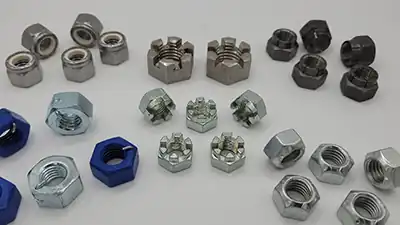
 Every day, customers call Bayou City Bolt looking for lock nuts. Sometimes they already know exactly what they need. More often, they don't. They know the fastener has to stay put, they know the equipment vibrates, and they know a standard nut has backed off before and don't want it to happen again.
What they don't always know is which type of lock nut makes the most sense. That's where the conversation begins. One of the first questions we ask usually isn't about thread size or material. It's: "What's the application?"
Is it going on heavy equipment? Industrial machinery? Structural steel? Will it see constant vibration? High temperatures? Moisture? Chemicals? The answers to those questions tell us far more than a part number ever could. Because there isn't one lock nut that's right for every application. Understanding those challenges is the first step toward choosing the right one.
Why Not Just Use a Standard Hex Nut?
For plenty of applications, you can. If the fastener isn't exposed to vibration, repeated movement, or changing loads, a standard hex nut may be all you need. But equipment doesn't always operate under ideal conditions.
Construction equipment bounces across rough terrain. Pumps cycle on and off thousands of times. Manufacturing equipment vibrates. Motors create constant movement. Heavy machinery absorbs repeated shock loads every day. Those forces have a way of working against threaded fasteners. Over time, even a properly tightened standard nut can begin to loosen.
Lock nuts were developed to solve that problem. Whether they use a nylon insert or an all-metal locking design, their job is the same: help maintain clamp load when vibration, movement, or demanding operating conditions would otherwise allow a standard nut to back off. The question isn't whether you need a lock nut — the question is which one.
When We Recommend Nylon Insert Lock Nuts
If someone calls us looking for a lock nut, there's a good chance we'll start by talking about nylon insert lock nuts, often called Nyloc nuts. They're one of the most versatile locking fasteners we stock, and for many applications, they're exactly the right solution.
Instead of relying on metal deformation, a Nyloc nut uses a nylon collar that's slightly smaller than the bolt's threads. As the nut is tightened, the nylon deforms around the threads, creating friction that helps resist loosening. You'll find nylon insert lock nuts on industrial equipment, machinery, transportation equipment, construction projects, and many everyday maintenance applications.
Features and advantages of Nylon Insert Lock Nuts include:
- Chemical & Moisture Resistance: The nylon insert itself is resistant to many chemicals and moisture, making these lock nuts an excellent option for wet or corrosive environments.
- Economical Solution: If the application isn't dealing with excessive heat or severe vibration, a nylon insert lock nut provides dependability without paying for performance you don't need.
When We'll Steer You Toward an All-Metal Lock Nut
Sometimes the application makes the decision for you: high temperatures, constant vibration, repeated shock loads, and heavy industrial equipment. Those are the situations where the conversation usually shifts toward all-metal lock nuts.
Unlike nylon insert lock nuts, these products create their locking action through carefully engineered metal deformation. They're designed to maintain prevailing torque, allowing the fastener to resist loosening even under demanding operating conditions. They're commonly specified throughout construction, heavy equipment, manufacturing, mining, oil and gas, and other industries where reliability isn't optional.
Not Every All-Metal Lock Nut Is the Same
Choosing an all-metal lock nut is only the beginning. The next step is selecting the style that best matches the application:
Stover Lock Nuts
If you're looking for an economical all-metal lock nut for high-vibration applications, a Stover lock nut is often where the conversation begins. Stover lock nuts offer dependable locking performance without adding unnecessary cost, making them a go-to solution for heavy shock loads and repeated movement.
Flexlock Nuts
When engineers need even greater holding power, they'll often specify Flexlock nuts. Their unique design provides additional locking performance while remaining removable with standard tools. We commonly supply Flexlock nuts for petrochemical facilities, industrial plants, and maintenance operations where equipment reliability is critical. They're also available in stainless steel for applications where corrosion resistance is equally important.
ANCO Lock Nuts
Manufactured by LOK-MOR®, these structural lock nuts use a ratchet pin locking mechanism that deforms into the bolt's threads, creating an exceptionally secure connection approved for structural and pipeline applications. They're frequently specified for drilling rigs, pipelines, structural steel, and high-vibration environments where loosening simply isn't an option. Because the ratchet pin intentionally engages the threads, ANCO lock nuts are designed as a non-reusable fastening solution for critical applications.
Can Lock Nuts Be Reused?
It's one of the most common questions we hear. Most nylon insert lock nuts and traditional all-metal lock nuts are classified as prevailing torque lock nuts. Their locking ability comes from intentional deformation, whether that's the nylon insert or the metal itself. Once that deformation has occurred, some of the locking capability can be lost.
For non-critical applications, reuse may sometimes be acceptable depending on the condition of the fastener. For critical applications involving safety, structural integrity, heavy vibration, or demanding operating conditions, replacing the lock nut is generally the recommended approach.
The Right Lock Nut Starts with the Right Questions
At Bayou City Bolt, we don't start by asking what part number you need. We start by asking what you're trying to accomplish. Is the equipment exposed to heat? Will it see constant vibration? Is corrosion a concern? Does it need to come apart later for maintenance?
We maintain a large inventory of standard and metric lock nuts, nylon insert lock nuts, all-metal lock nuts, fine-thread sizes, specialty patterns, and hard-to-find products. If you're not sure which lock nut is right for your application, contact Bayou City Bolt or explore our inventory. We'll help you ask the right questions, identify the right product, and get your project moving again.